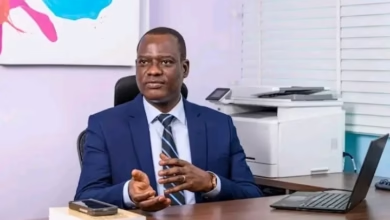

The Nigeria Labour Congress (NLC) has declared the current N70,000 minimum wage completely unsustainable launching a nationwide push for an urgent wage review that reflects the country’s soaring inflation and economic realities. The demand comes amid growing worker discontent across Nigeria’s states and a potential nationwide strike over unrelated labor disputes.
National Discontent: Workers Struggle Despite Wage IncreasesDespite
President Bola Tinubu’s approval of the N70,000 minimum wage last year, workers across Nigeria report that the increase has been rendered meaningless by hyperinflation, with many states struggling to implement even this inadequate wage.According to widespread testimony from civil servants, the current minimum wage fails to cover basic necessities, forcing workers to adopt various side hustles for survival. Sulaiman Aminu Yakasai, a civil servant in Kano State where the government implemented a slightly higher wage of N71,000, stated: “Even the minimum wage we get is still not enough for us and our family. So I usually go to market after closing hours and on weekends to make ends meet” .The situation is particularly dire in states like Kaduna, where workers report incomplete implementation and worsening conditions. A Kaduna-based teacher identified only as Abdul described workers as being “treated like slaves,” adding that “our minimum wage can’t even take care of our families” .
The Lagos State NLC chapter had previously demanded N150,000, arguing that even the state’s current N85,000 minimum wage – the highest in the country – was inadequate for Nigeria’s commercial capital where costs of accommodation, transport, feeding, and utilities are significantly higher than elsewhere .
Government Response and Economic Realities
State governments have largely rejected these demands as unrealistic, with proposals ranging from N45,000 to N80,000. Bauchi State Governor Bala Mohammed proposed N45,000, while Adamawa State’s government suggested the same amount . Plateau State government proposed between N60,000 and N80,000 .Finance Minister Wale Edun, speaking at the Southwest zonal public hearing in Lagos, promised workers “a living wage that is fair and sustainable” but stressed that any wage increase must be matched by increased productivity .”We have all agreed that if there is an increase in the minimum wage, there should be an increase in productivity,” Edun stated, adding that “when workers become more productive, companies become more profitable and then we will be able to afford the increase in the national minimum wage without causing inflation” .
The Federal Government has constituted a 37-member Tripartite Committee to negotiate the new minimum wage, with public hearings held across all six geo-political zones . Broader Context of Labor Unrest The minimum wage demand comes amid other significant labor disputes, including a potential strike by the Nigeria Union of Petroleum and Natural Gas Workers (NUPENG) against the Dangote Refinery over anti-union practices .NUPENG has accused Africa’s richest man, Aliko Dangote, of planning to import 4,000 compressed natural gas-powered trucks and prohibiting the drivers from joining any union.
The union has threatened to begin industrial action on Monday, September 8, if the situation remains unresolved .The NLC has thrown its weight behind NUPENG, with President Joe Ajaero describing Dangote Group’s practices as “crude and dangerous” and alleging similar complaints across the conglomerate’s cement, sugar, and flour operations .

Daily Frontier is committed to being a trusted source of accurate and timely news, offering in-depth coverage of current affairs, emerging trends, and critical issues shaping today’s world